Posts

How to better manage back-to-back video meetings and reduce stress?

Research is proving that the human brain needs breaks and that back-to-back video meetings without breaks induce an accumulation of stress levels and decrease the ability to focus and engage. The spike of stress also happens when transitioning from one meeting to the next one.

More information: Research proves your brain needs breaks

Most employees and managers have had such experience in the new era of virtual work (or work-from-home). However, the reality is that this situation also happened at the office when back-to-back face-to-face meetings were scheduled for the whole morning/afternoon/day.

How to manage such situation for the best outcome of everyone?

Very simple! Make breaks! Take breaks! Schedule breaks!

How to organize your agenda?

Companies, managers and employees have a role to play in setting up better practices for scheduling meetings. Improved features in Calendar tools would also greatly facilitate the process.

For example, a 30mn-meeting could last 25min and provide a 5min break. Or a 1h-meeting could be reduced to 45min and provide a 15min break before the next one. Alternatively, the 1h-meeting can become 50min with 10min break. However, such a new convention must be reflected in calendar appointments and visible in calendars. Else meetings will naturally revert back to 30min or 1h. And all positive effects of breaks on the brain will vanish.

More information: Research proves your brain needs breaks

Digital Transformation… the missing element

Introduction

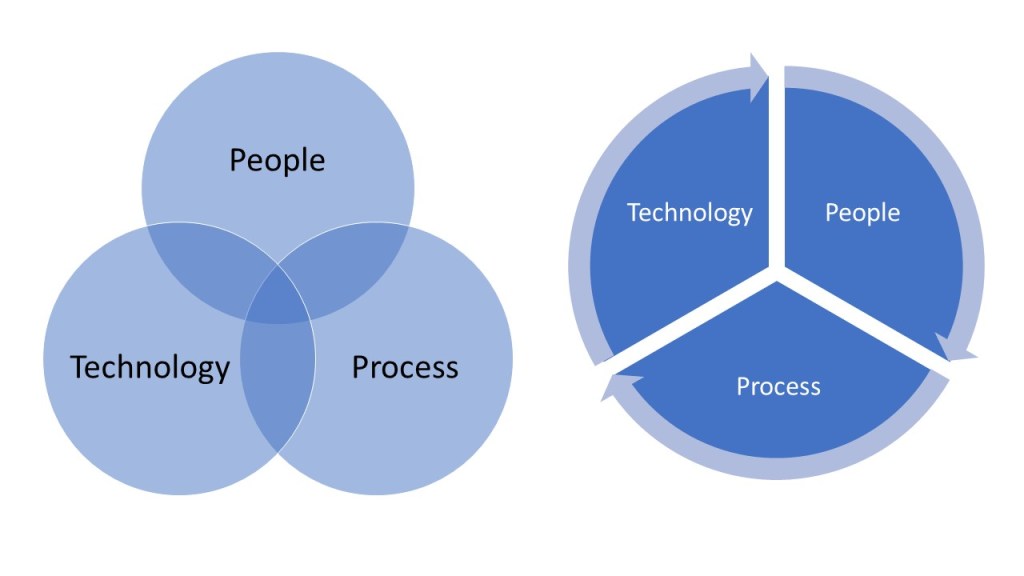
When looking at any Transformation initiative, most experts would concur on saying that it should encompass 3 domains i.e. People, Process and Technology (PPT). Typically such a PPT framework states that a good balance between the 3 components needs to be maintained for any organizational transformation, digital or not, as People perform tasks using Processes facilitated and streamlined by Technology. Therefore, for the success of the Transformation and for defining the future state, all 3 components People, Process and Technology must be considered and reviewed.

A little bit of history

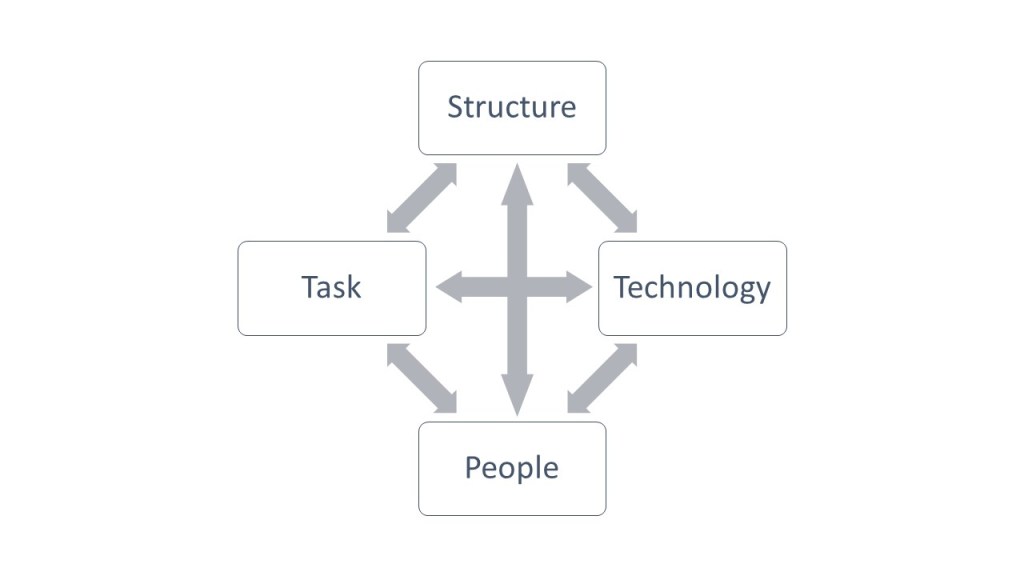
Back in 1965, Harold J. Leavitt from Carnegie Institute of Technology wrote a paper titled “Applied Organisational Change in Industry: Structural, Technological and Humanistic Approaches”. He explained that industrial organizations are complex systems in which 4 large variables are interacting: Task variables, Structural variables, Technological variables and Human variables.

  • Task refers to the production of goods or services
  • Human refer to people
  • Technology refers to tools, machines and computers
  • Structure refers to systems of authority, systems of communication and systems of workflow

As these 4 variables are highly interdependent, any change in one variable results in a change (compensatory or retaliatory) in another variable. Usually, efforts to effect change are ultimately designed to influence the Task variable (e.g. produce goods faster or cheaper). Thus, structural change should consider the performance of the other variables: Structure, Technology and People.

Diamond model by Harold J. Leavitt

The missing element in the People, Process and Technology framework

Based on recent engagements with large companies in South-East Asia, a Digital Transformation initiative may very often require a review of the company structure (or part of) as well as the definition of the new Roles & Responsibilities, KPIs and Policies.

Example 1

In a large manufacturing company with multiple product lines, should Procurement be centralized or decentralized? Or in other words, what should be centralized, what should be decentralized and what should be the interactions between the Central Procurement office and the Product Lines Procurement departments? What should be the workflows between these departments? What should be the organizations KPIs? Obviously such a Structural decision with newly defined Procurement policies, approvals and roles will heavily impact all other components i.e. People, Process and Technology.

Example 2

In an other large manufacturing company, the Digital Transformation would involve changing the core ERP system and all associated custom-developed applications running on local servers. The IT team is fully busy keeping the lights on, would need to learn new skills and adjust its internal organization, processes and tools. There is nothing really new here as such a situation happens in almost every large Transformation initiative. However, the interim IT Structure (incl. R&R, KPIs and policies) as well as the future-state IT Structure (incl. R&R, KPIs and policies) would need to be defined so that the other components i.e. People, Process and Technology can be adapted too.

Conclusion

For an effective and successful organizational Transformation or Change, not only the usual People, Process and Technology components should be considered. The often-forgotten or neglected Structure component should also be added into the picture together with its corresponding Roles & Responsibilities, KPIs, Workflows and Policies.


Read also:

Digital Transformation… will it succeed or will it fail?


Reference:
Harold J. Leavitt, Carnegie Institute of Technology “Applied Organisational Change in Industry: Structural, Technological and Humanistic Approaches”.

OECD PISA 2018 – How is South-East Asia / ASEAN faring? (Final – What is next ? Personal comments)


About PISA

The OECD Programme for International Student Assessment (PISA) examines what students know in reading, mathematics and science, and what they can do with what they know. It provides the most comprehensive and rigorous international assessment of student learning outcomes to date.

Results from PISA indicate the quality and equity of learning outcomes attained around the world, and allow educators and policy makers to learn from the policies and practices applied in other countries. 

PISA assesses the cumulative outcomes of education and learning at a point at which most children are still enrolled in formal education: the age of 15.


What is next?

The three volumes of PISA 2018 results, that have been
published in December 2019 and summarised in my last 3 posts, provide the first findings from this latest PISA assessment. In 2020, OECD will published the last volume , which will highlight some of the policies and practices that predict the success of students, schools and education system.

The PISA 2018 results offer a snapshot of education systems at a certain moment in time; but they do not – they cannot – show how the school systems got to that point, or the institutions and organisations that might have helped or hindered progress. That is where the OECD brings a range of other tools to strengthen insights for policy and practice.

The demands on education and education policy are high and rising. In the past it was sufficient for education to sort students because our economies and societies could rely on a few highly educated individuals. In today’s world, everyone needs to have advanced knowledge and skills, not just for economic reasons but also for social participation. The best-performing PISA countries show that high-quality and equitable education is an attainable goal, that it is within countries’ means to deliver a future for millions
of learners who currently do not have one.

My personal comments on tertiary education

While education policy makers and also practitioners will do their best to fine-tune the education systems and policies based on PISA results, I think that the Business world also has a very significant role to play in tomorrow’s education of new generations, especially in tertiary education.

In the past and it is still the case today, education was and is still being delivered to students in the first part of their life (let’s say from 3 to 25 years-old) before they join the workforce. While working from 25 to 65 years-old or even beyond, adults will receive minimal education, except for the bare minimum of operational training. Very few adults will go back to university benches to upgrade their skills and knowledge on the latest technologies that were unknown 10 years before. Virtually no one will do it on a regular basis (let’s say every 5 years) during their professional career. The barriers between Education and Work should be totally abolished as the pace and the disruption of innovation and technology mandates a much more flexible approach of life-long learning, integration of subjects and integration of learning situations.

The future of life-long education will probably include a combination of yearly internships with solid tutorage, apprenticeship for most tertiary degrees, quinquennial learning programs of 4-6 weeks for every professional, teaching or experience-sharing with students & learners and a much wider use of MOOC and on-line curriculas.

What is your view on this topic? Does your company employs many interns or apprentices? How often do you earn an on-line certificate from a MOOC course?
Feel free to comment…


Source: OECD, PISA 2018 Database, Tables I.B1.10, I.B1.11, I.B1.12, I.B1.26 and I.B1.27.


OECD PISA 2018 – How is South-East Asia / ASEAN faring?

Part 1 – Reading
Part 2 – Mathematics
Part 3 – Science
Final – What is next?


References

OECD PISA reports: click here
OECD PISA 2018 Volume I – What Students know and can do: click here

OECD (2019), PISA 2018 Results (Volume I): What Students Know and Can Do, PISA, OECD Publishing, Paris, https://doi.org/10.1787/5f07c754-en.


Some press articles after the publication of PISA 2018 results

1. China: click here
2. Singapore: click here
3. Malaysia: click here
4. Indonesia: click here
5. Thailand: click here
6. Philippines: click here
7. Brunei: click here
8. Vietnam: click here



OECD PISA 2018 – How is South-East Asia / ASEAN faring? (Part 3 – Science)


About PISA

The OECD Programme for International Student Assessment (PISA) examines what students know in reading, mathematics and science, and what they can do with what they know. It provides the most comprehensive and rigorous international assessment of student learning outcomes to date.

Results from PISA indicate the quality and equity of learning outcomes attained around the world, and allow educators and policy makers to learn from the policies and practices applied in other countries. 

PISA assesses the cumulative outcomes of education and learning at a point at which most children are still enrolled in formal education: the age of 15.


Introduction

The results of the PISA 2018 study have been published on December 3rd, 2019. Reading was the main subject assessed in PISA 2018 as reading proficiency is essential for a wide variety of human activities – from following instructions in a manual; to finding out the who, what, when, where and why of an event; to communicating with others for a specific purpose or transaction.


Highlights from PISA 2018 – Science

China (represented by Beijing, Shanghai, Jiangsu and Zhejiang) and Singapore obtained the highest scores than all other countries/ economies and are ranked #1 and #2 for mathematics proficiency followed by Macau #3.

Estonia, Japan, Finland, Korea were the highest‑performing OECD countries in science and ranked #4, #5, #6 and #7 respectively.

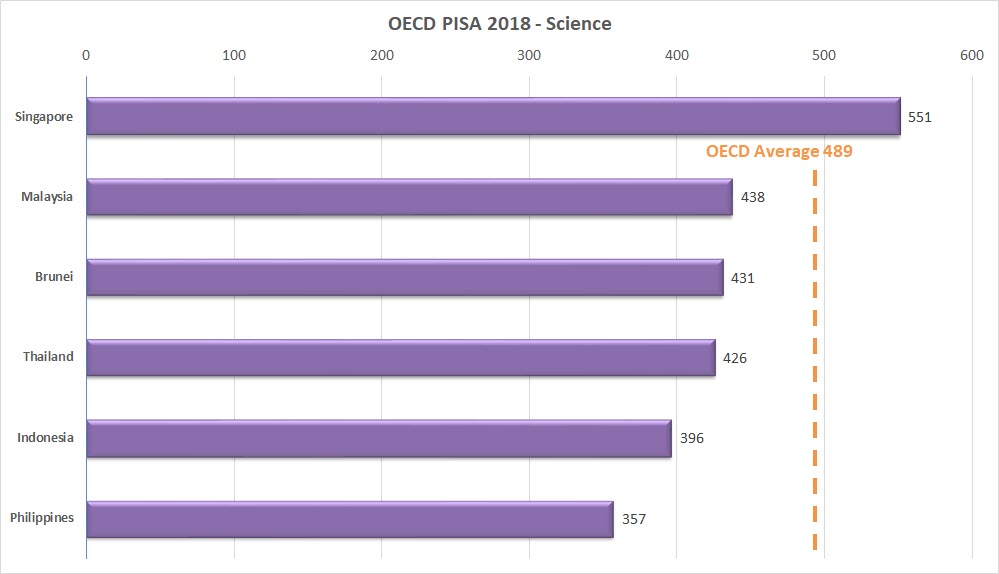
Malaysia, Brunei, Thailand, Indonesia and Philippines scored significantly below the OECD average and were respectively ranked #47, #49, #52, #69 and #76 out of the 77 countries listed in the final report for comparison of performance.


Detailed results for PISA 2018 – Science

Mean score in Science
Source: OECD, PISA 2018 Database, Tables I.B1.10, I.B1.11, I.B1.12, I.B1.26 and I.B1.27.


OECD PISA 2018 – How is South-East Asia / ASEAN faring?

Part 1 – Reading
Part 2 – Mathematics
Part 3 – Science
Final – What is next?


References

OECD PISA reports: click here
OECD PISA 2018 Volume I – What Students know and can do: click here

OECD (2019), PISA 2018 Results (Volume I): What Students Know and Can Do, PISA, OECD Publishing, Paris, https://doi.org/10.1787/5f07c754-en.


Some press articles after the publication of PISA 2018 results

1. China: click here
2. Singapore: click here
3. Malaysia: click here
4. Indonesia: click here
5. Thailand: click here
6. Philippines: click here
7. Brunei: click here
8. Vietnam: click here


OECD PISA 2018 – How is South-East Asia / ASEAN faring? (Part 2 – Mathematics)


About PISA

The OECD Programme for International Student Assessment (PISA) examines what students know in reading, mathematics and science, and what they can do with what they know. It provides the most comprehensive and rigorous international assessment of student learning outcomes to date.

Results from PISA indicate the quality and equity of learning outcomes attained around the world, and allow educators and policy makers to learn from the policies and practices applied in other countries. 

PISA assesses the cumulative outcomes of education and learning at a point at which most children are still enrolled in formal education: the age of 15.


Introduction

The results of the PISA 2018 study have been published on December 3rd, 2019. Reading was the main subject assessed in PISA 2018 as reading proficiency is essential for a wide variety of human activities – from following instructions in a manual; to finding out the who, what, when, where and why of an event; to communicating with others for a specific purpose or transaction.


Highlights from PISA 2018 – Mathematics

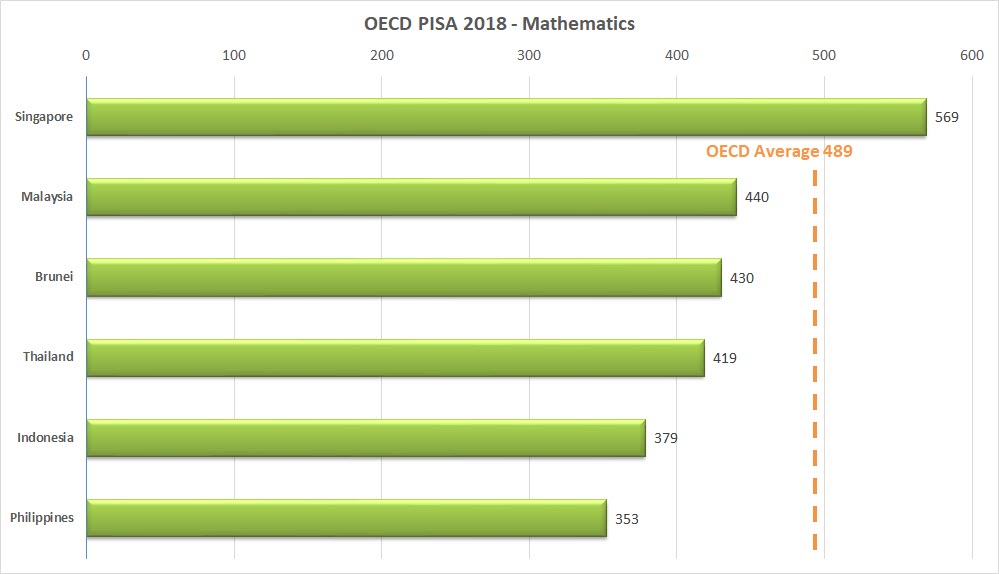
China (represented by Beijing, Shanghai, Jiangsu and Zhejiang) and Singapore obtained the highest scores than all other countries/ economies and are ranked #1 and #2 for mathematics proficiency.

Macau, Hong-Kong, Taipei, Japan, Korea took the #2 to #7 rankings meaning that the Top 7 countries for mathematics proficiency are all in Asia.

Estonia, Netherlands, Poland and Switzerland were the highest‑performing OECD countries in mathematics after Japan and Korea and ranked #8, #9, #10 and #11 respectively.

Malaysia, Brunei, Thailand, Indonesia and Philippines scored significantly below the OECD average and were respectively ranked #46, #50, #56, #71 and #76 out of the 77 countries listed in the final report for comparison of performance.


Detailed results for PISA 2018 – Mathematics

Mean score in Mathematics
Source: OECD, PISA 2018 Database, Tables I.B1.10, I.B1.11, I.B1.12, I.B1.26 and I.B1.27.


OECD PISA 2018 – How is South-East Asia / ASEAN faring?

Part 1 – Reading
Part 2 – Mathematics
Part 3 – Science
Final – What is next?


References

OECD PISA reports: click here
OECD PISA 2018 Volume I – What Students know and can do: click here

OECD (2019), PISA 2018 Results (Volume I): What Students Know and Can Do, PISA, OECD Publishing, Paris, https://doi.org/10.1787/5f07c754-en.


Some press articles after the publication of PISA 2018 results

1. China: click here
2. Singapore: click here
3. Malaysia: click here
4. Indonesia: click here
5. Thailand: click here
6. Philippines: click here
7. Brunei: click here
8. Vietnam: click here


OECD PISA 2018 – How is South-East Asia / ASEAN faring? (Part 1 – Reading)


About PISA

The OECD Programme for International Student Assessment (PISA) examines what students know in reading, mathematics and science, and what they can do with what they know. It provides the most comprehensive and rigorous international assessment of student learning outcomes to date.

Results from PISA indicate the quality and equity of learning outcomes attained around the world, and allow educators and policy makers to learn from the policies and practices applied in other countries. 

PISA assesses the cumulative outcomes of education and learning at a point at which most children are still enrolled in formal education: the age of 15.


Introduction

The results of the PISA 2018 study have been published on December 3rd, 2019. Reading was the main subject assessed in PISA 2018 as reading proficiency is essential for a wide variety of human activities – from following instructions in a manual; to finding out the who, what, when, where and why of an event; to communicating with others for a specific purpose or transaction.


Highlights from PISA 2018 – Reading

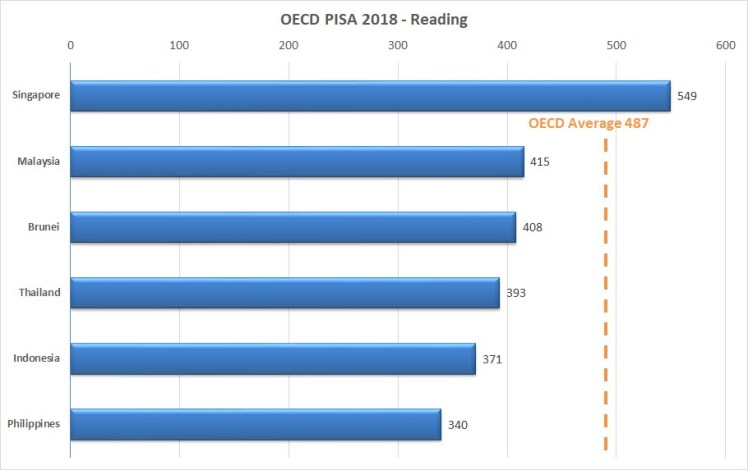
China (represented by Beijing, Shanghai, Jiangsu and Zhejiang) and Singapore scored significantly higher in reading than all other countries/ economies and are ranked #1 and #2 for reading proficiency.

Estonia, Canada, Finland and Ireland were the highest‑performing OECD countries in reading and ranked #4, #5, #6 and #7 respectively.

Malaysia, Brunei, Thailand, Indonesia and Philippines scored significantly below the OECD average and were respectively ranked #56, #59, #66, #72 and #77 out of the 77 countries listed in the final report for comparison of performance.


Detailed results for PISA 2018 – Reading

Mean score in Reading
Source: OECD, PISA 2018 Database, Tables I.B1.10, I.B1.11, I.B1.12, I.B1.26 and I.B1.27.


OECD PISA 2018 – How is South-East Asia / ASEAN faring?

Part 1 – Reading
Part 2 – Mathematics
Part 3 – Science
Final – What is next?


References

OECD PISA reports: click here
OECD PISA 2018 Volume I – What Students know and can do: click here

OECD (2019), PISA 2018 Results (Volume I): What Students Know and Can Do, PISA, OECD Publishing, Paris, https://doi.org/10.1787/5f07c754-en.


Some press articles after the publication of PISA 2018 results

1. China: click here
2. Singapore: click here
3. Malaysia: click here
4. Indonesia: click here
5. Thailand: click here
6. Philippines: click here
7. Brunei: click here
8. Vietnam: click here


Digital Transformation… will it succeed or will it fail?

Back in 1995, John P. Kotter published an article in the Harvard Business Review titled “Leading change: Why Transformation efforts fail?”
At that time, he listed a set of 8 errors that he had observed over a decade. We are now in 2019 i.e. 25 years later and these errors are still happening today.

Error #1: Not Establishing a Great Enough Sense of Urgency
I can see companies today that are talking about transformation however there is no leadership call on a hard timeline. Top management is paralyzed, does not see it as a priority on the agenda and nothing will happen as a result.

Error #2: Not Creating a Powerful Enough Guiding Coalition
Although a Transformation can be initiated by the idea of 1 person, it cannot be sustained by that 1 person through the iterations and cycles of decisions and management reviews in any large company. Unless this idea is offshoot as a start-up outside the organization. Otherwise, a team of dedicated leaders, managers and experts must be assembled and grow over time. If expertise is not available inside, budgets must be allocated to bring in the required external expertise & knowledge. I can see companies today trying to leverage their current internal structure exclusively for their digital transformation. and not allocating any budget. This can only fail as everyone is 1. busy with day-to-day operations, 2. not empowered to transform, 3. largely resistant to change due to fear and 4. there is not enough knowledge internally. Here again, this can only fail.

Error #3: Lacking a Vision
In my opinion, this is the most critical error and I would actually move it to the top of list. Without a vision, there will be no timeline and no guiding coalition. The vision has to be imagined by the company founder or the actual CEO. This is a top-down approach and I will comment on this in a specific post. The vision is about WHY the company is going to transform. The HOW and the WHAT can be defined once the WHY is known. Talking about the HOW or the WHAT is a futile exercise if the destination (the WHY or the Vision) is not known. Transformation initiatives without a Vision and Mission statement fail and will continue to fail.

The 5 other errors are in the HBR article (see link below)


Read also

Digital Transformation… the missing element


References

Harvard Business Review: Leading Change: Why Transformation Efforts Fail
Books: John P. Kotter books on amazon.com